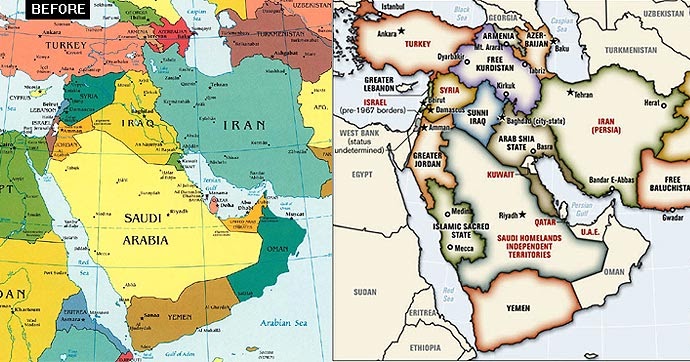
To 2019 το iEpikaira έγραφε σε ανάλυσή του:
“Το σχέδιο Oded Yinon από το 1982 προέβλεπε την δημιουργία του Μεγάλου Ισραήλ με την παράλληλη στήριξη των Κούρδων ως στρατηγικός σύμμαχος του Ισραήλ, μετατρέποντάς τους σε «μακρύ χέρι» στην ευρύτερη περιοχή. Βάσει του σχεδίου αυτού, προβλεπόταν να πυροδοτηθεί ρήξη μεταξύ των διαφόρων θρησκευτικών δογμάτων των Αράβων και ενόσω αυτοί θα αντιμάχονται μεταξύ τους, θα επιτυγχάνονταν η ασφάλεια του Ισραήλ και η εδραιοποίησή του ως κυρίαρχο κράτος στην Μέση Ανατολή.”
Το 2013 οι New York Times δημοσίευσαν την παρακάτω ανάλυση:
.jpg)
Imagining a Remapped Middle East
By Robin Wright (Sept. 28, 2013)
THE map of the modern Middle East, a political and economic pivot in the international order, is in tatters. Syria’s ruinous war is the turning point. But the centrifugal forces of rival beliefs, tribes and ethnicities — empowered by unintended consequences of the Arab Spring — are also pulling apart a region defined by European colonial powers a century ago and defended by Arab autocrats ever since.
A different map would be a strategic game changer for just about everybody, potentially reconfiguring alliances, security challenges, trade and energy flows for much of the world, too.
Syria’s prime location and muscle make it the strategic center of the Middle East. But it is a complex country, rich in religious and ethnic variety, and therefore fragile. After independence, Syria reeled from more than a half-dozen coups between 1949 and 1970, when the Assad dynasty seized full control. Now, after 30 months of bloodletting, diversity has turned deadly, killing both people and country. Syria has crumbled into three identifiable regions, each with its own flag and security forces. A different future is taking shape: a narrow statelet along a corridor from the south through Damascus, Homs and Hama to the northern Mediterranean coast controlled by the Assads’ minority Alawite sect. In the north, a small Kurdistan, largely autonomous since mid-2012. The biggest chunk is the Sunni-dominated heartland.
Syria’s unraveling would set precedents for the region, beginning next door. Until now, Iraq resisted falling apart because of foreign pressure, regional fear of going it alone and oil wealth that bought loyalty, at least on paper. But Syria is now sucking Iraq into its maelstrom.
“The battlefields are merging,” the United Nations envoy Martin Kobler told the Security Council in July. “Iraq is the fault line between the Shia and the Sunni world and everything which happens in Syria, of course, has repercussions on the political landscape in Iraq.”
Over time, Iraq’s Sunni minority — notably in western Anbar Province, site of anti-government protests — may feel more commonality with eastern Syria’s Sunni majority. Tribal ties and smuggling span the border. Together, they could form a de facto or formal Sunnistan. Iraq’s south would effectively become Shiitestan, although separation is not likely to be that neat.
The dominant political parties in the two Kurdish regions of Syria and Iraq have longstanding differences, but when the border opened in August, more than 50,000 Syrian Kurds fled to Iraqi Kurdistan, creating new cross-border communities. Massoud Barzani, president of Iraqi Kurdistan, has also announced plans for the first summit meeting of 600 Kurds from some 40 parties in Iraq, Syria, Turkey and Iran this fall.
“We feel that conditions are now appropriate,” said Kamal Kirkuki, the former speaker of Iraq’s Kurdish Parliament, about trying to mobilize disparate Kurds to discuss their future.
Outsiders have long gamed the Middle East: What if the Ottoman Empire hadn’t been divvied up by outsiders after World War I? Or the map reflected geographic realities or identities? Reconfigured maps infuriated Arabs who suspected foreign plots to divide and weaken them all over again.
I had never been a map gamer. I lived in Lebanon during the 15-year civil war and thought it could survive splits among 18 sects. I also didn’t think Iraq would splinter during its nastiest fighting in 2006-7. But twin triggers changed my thinking.
The Arab Spring was the kindling. Arabs not only wanted to oust dictators, they wanted power decentralized to reflect local identity or rights to resources. Syria then set the match to itself and conventional wisdom about geography.
New borders may be drawn in disparate, and potentially chaotic, ways. Countries could unravel through phases of federation, soft partition or autonomy, ending in geographic divorce.
Libya’s uprising was partly against the rule of Col. Muammar el-Qaddafi. But it also reflected Benghazi’s quest to separate from domineering Tripoli. Tribes differ. Tripolitanians look to the Maghreb, or western Islamic world, while Cyrenaicans look to the Mashriq, or eastern Islamic world. Plus, the capital hogs oil revenues, even though the east supplies 80 percent of it.
So Libya could devolve into two or even three pieces. The Cyrenaica National Council in eastern Libya declared autonomy in June. Southern Fezzan also has separate tribal and geographic identities. More Sahelian than North African in culture, tribes and identity, it could split off too.
Other states lacking a sense of common good or identity, the political glue, are vulnerable, particularly budding democracies straining to accommodate disparate constituencies with new expectations.
After ousting its longtime dictator, Yemen launched a fitful National Dialogue in March to hash out a new order. But in a country long rived by a northern rebellion and southern separatists, enduring success may depend on embracing the idea of federation — and promises to let the south vote on secession.
A new map might get even more intriguing. Arabs are abuzz about part of South Yemen’s eventually merging with Saudi Arabia. Most southerners are Sunni, as is most of Saudi Arabia; many have family in the kingdom. The poorest Arabs, Yemenis could benefit from Saudi riches. In turn, Saudis would gain access to the Arabian Sea for trade, diminishing dependence on the Persian Gulf and fear of Iran’s virtual control over the Strait of Hormuz.
The most fantastical ideas involve the Balkanization of Saudi Arabia, already in the third iteration of a country that merged rival tribes by force under rigid Wahhabi Islam. The kingdom seems physically secured in glass high-rises and eight-lane highways, but it still has disparate cultures, distinct tribal identities and tensions between a Sunni majority and a Shiite minority, notably in the oil-rich east.
Social strains are deepening from rampant corruption and about 30 percent youth unemployment in a self-indulgent country that may have to import oil in two decades. As the monarchy moves to a new generation, the House of Saud will almost have to create a new ruling family from thousands of princes, a contentious process.
Other changes may be de facto. City-states — oases of multiple identities like Baghdad, well-armed enclaves like Misurata, Libya’s third largest city, or homogeneous zones like Jabal al-Druze in southern Syria — might make a comeback, even if technically inside countries.
A century after the British adventurer-cum-diplomat Sir Mark Sykes and the French envoy François Georges-Picot carved up the region, nationalism is rooted in varying degrees in countries initially defined by imperial tastes and trade rather than logic. The question now is whether nationalism is stronger than older sources of identity during conflict or tough transitions.
Syrians like to claim that nationalism will prevail whenever the war ends. The problem is that Syria now has multiple nationalisms. “Cleansing” is a growing problem. And guns exacerbate differences. Sectarian strife generally is now territorializing the split between Sunnis and Shiites in ways not seen in the modern Middle East.
But other factors could keep the Middle East from fraying — good governance, decent services and security, fair justice, jobs and equitably shared resources, or even a common enemy. Countries are effectively mini-alliances. But those factors seem far off in the Arab world. And the longer Syria’s war rages on, the greater the instability and dangers for the whole region.
*Robin Wright is the author of “Rock the Casbah: Rage and Rebellion Across the Islamic World” and a distinguished scholar at the United States Institute of Peace and the Wilson Center.
Source: https://www.nytimes.com/2013/09/29/opinion/sunday/imagining-a-remapped-middle-east.html
Στη συνέχεια ας διαβάσουμε και μια πιο διεισδυτική -κατά άλλους, συνωμοσιολογική- ανάλυση του 2014, με σαφείς αναφορές στο σχέδιο Oded Yinon:
Balkanization and US’ full spectrum dominance
Sultana Afroz (Tue Sep 16, 2014 12:00 AM. Last update on: Sun Mar 8, 2015 01:53 AM)
The above map was prepared by Lieutenant-Colonel Ralph Peters. It was published in the Armed Forces Journal in June 2006, Peters is a retired colonel of the U.S. National War Academy. (Map Copyright Lieutenant-Colonel Ralph Peters 2006).
THE tentacles of the balkanization policy of fragmenting states into small entities has spread worldwide initiated by civil rights societies at first with protests which have the flare of popular uprisings against the incumbent governments for democracy, human rights, minority rights and secularism. More is yet to come in the Middle East using local collaborators and once the West has achieved its objective it will discard them as they did with Saddam Hussein and are now in the process of doing with Nouri Al-Maliki in Iraq. One must remember how Al-Qaeda had been declared enemy “Number One” by the US-NATO yet Al-Qaeda is fighting on the side of the US-NATO in Syria (Al-Nusrat) and Al-Qaeda groups (LIFG) listed among the UN terror list deposed Muammar Gaddafi and destroyed Libya, which ranked as the number one country in Africa under the UN Human Index.
Aside from the balkanization of Iraq, the Yinon Plan calls for a divided Lebanon, Egypt, and Syria. Lt. Colonel Ralph Peters assigned to the Office of the deputy Chief of Staff for Intelligence had redrawn the map of the Middle East as far as Baluchistan, a province of Pakistan and called it “Blood Borders”.
The creation of Kurdistan will change the existing map of Turkey, Iran and Syria besides that of Iraq. Saudi Arabia and Jordan will not remain immune from the New Middle East. A new Palestinian state may emerge in the existing Hashemite Kingdom of Jordan, which traditionally is greater Palestine. Israel will enjoy the entire Palestinian territory as it existed under the British Mandate. West Bank, the proposed territory for the Palestinian state is a reservoir for fresh underground water and Gaza offshore contains rich gas fields. Thus Palestine is never to be realized. The Palestinian Authority is fictitious as there is no Palestine since 1948. President Obama had said at the AIPAC Conference, following his selection as the Presidential candidate for the Democratic Party in the US Presidential Election in 2007 that Jerusalem will remain as the indivisible capital of Israel. Every effort to have Peace Talk between Israel and the Palestinian Authority for a two-state solution since President Obama came to power is an illusion for there can be no Palestine without (East) Jerusalem as the capital. The Hashemite dynasty may find itself reverted to its traditional home in the Hejaz. Fred Halliday, the author of Arabia Without Sultans suggests that in the wake of any threat to the flow of Saudi oil to the West, there may be no kingdom but a divided Arabian Peninsula with its eastern section under direct US military control and the western section, the Hejaz with sacred cities of Makkah and Madinah under the Hashemite control. The map prepared by Peters is also indicative of independent states in the existing central and eastern Saudi territories and of an Islamic Sacred State along the Hejaz.
The Balkanization of the MENA region falls in line with Pentagon’s Full Spectrum Dominance Doctrine”, which aims for the dominance of the world in every aspect: strategic, political, economic (agricultural and non-agricultural) cultural and military (nuclear and conventional) by the United States in the wake of a rising China as a global power in alliance with a reemerging Russia, and several multilateral blocs such as BRICS and SCO to name a few, challenging the western monetary system backed by a show of military power. For the implementation of the Full Spectrum Dominance, Pentagon has set up Command Centres throughout the world such as the EU Command, CENTCOM, AFRICOM and SOUTHCOM. With over 800 bases overseas, the Command Centres serve as intelligence headquarters for each specific region, promoting American and western economic and strategic interests. The Balkanization Plan, which ensures a better US grip over small states extends into the former Soviet territories in Eastern Europe (Ukraine and Georgia) and Central Asia, African continent covering Egypt, Somalia, Libya, Sudan, Nigeria, Chad, Kenya, and even includes the Peoples Republic of China, which has seen disturbances in Xingjian and Tibet. Since the US-NATO occupation of Afghanistan in 2001, the extreme western region of Xingjian province of China, which borders Afghanistan, has seen repeated insurgencies in Muslim communities. The Chinese government has expressed concern about the security in that region and says Muslim extremists receive help from neighboring countries. Also of security concern for the Chinese is Tibet where Human Rights Activists incite pro-Tibet protests and a group called Reporters without Borders staged their protest at the Beijing Summer Olympics in 2008. India which houses the exiled Tibetan government is suspected of inciting protests against the Chinese authorities within Tibet. Ralph
Peters echoed the sad consequences of the Balkanization Plan as envisioned under Pentagon’s “Full Spectrum Dominance Doctrine” in 1997:
There will be no peace. At any given moment for the rest of our lifetimes, there will be multiple conflicts in mutating forms around the globe. Violent conflict will dominate the headlines….The de facto role of the US armed forces will be to keep the world safe for our economy and open to our cultural assault. To those ends, we will do a fair amount of killing.
With regard to the role of Israel in this mayhem, former Secretary Kissinger said when “the great Russian bear and Chinese sickle will be roused from their slumber and this is when Israel will have to fight with all its might and weapons to kill as many Arabs as it can. Hopefully if all goes well, half the Middle East will be Israel”. Russian and Chinese veto at the Security Council against US-UK-EU resolution to militarily intervene in the Syrian civil war and the formation of the Palestinian unity government, which has received worldwide acclamation are perhaps, warning bells for Israel to wage an all-out war against the Arabs to maintain its hegemonic dominance in the MENA region, through the full implementation of the Yinon Plan.
Source: https://www.thedailystar.net/balkanization-and-us-full-spectrum-dominance-41819
Για όσους έχουν ακόμη αμφιβολίες για το τί συμβαίνει, παραθέτουμε και το εξώφυλλο του Economist του 2012 σημειώνοντας την παρουσία του σημερινού ισραηλινού πρωθυπουργού στο επάνω μέρος:
 |
| Economist Cover illustration – A rough guide to Hell – Cover artwork from our 2012 Christmas double issue |
Εάν οι αμφιβολίες παραμένουν, θέτουμε και το απλό ερώτημα, εάν η σημερινή κατάσταση θυμίζει ή όχι κάτι από τα προαναφερθέντα; Περισσότερα και ΕΔΩ!
Πηγή: i-epikaira.blogspot.com